PRODUCT
Achieving Zero Thermal Expansion
New Material: "Negative Thermal Expansion Material" TRANZiQ™
Minimize thermal expansion caused by rising temperatures to maintain the product's dimensional accuracy.
Negative thermal expansion material TRANZiQ™ are a new and indispensable option for electronic devices and high-precision products.
PROBLEM
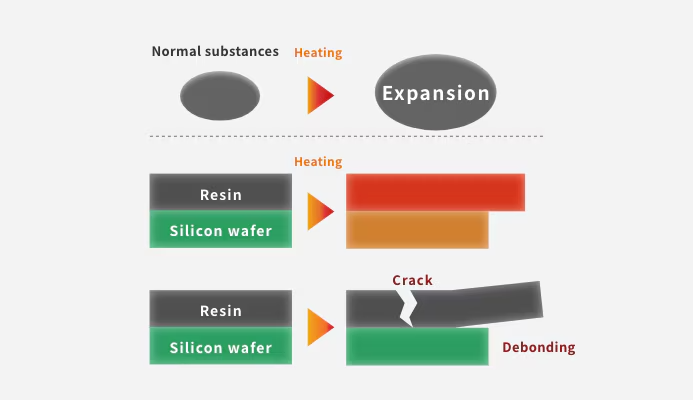
Are you struggling with thermal expansion issues like this?
- Cracks, delamination, and deformation occur due to the thermal expansion of the materials
- Cracks and distortions occur, reducing the reliability of the material
- Thermal expansion causes delamination at joint surfaces, such as those held together by adhesives or solder.
SOLUTION
Mitsui Kinzoku's "Negative Thermal Expansion Material" TRANZiQ™ You can solve this by using it
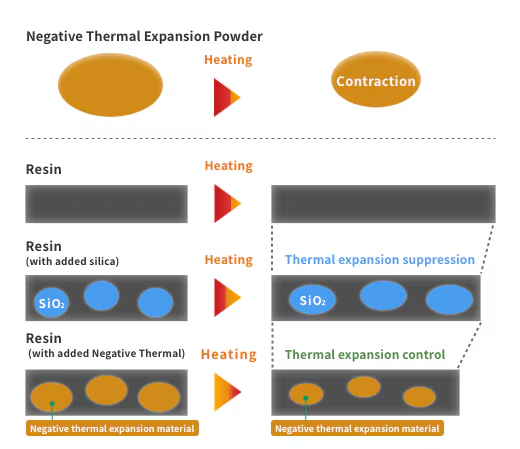
Advanced Thermal Expansion Control Using Negative Thermal Expansion Material TRANZiQ™
Negative thermal expansion material TRANZiQ™ are special materials that contract as the temperature rises.
By taking advantage of this property, it is possible to suppress the expansion of materials such as resins that tend to expand when heated.
Currently, inorganic fillers such as silica are used to suppress the expansion of resins; however, as electronic devices continue to evolve, there is a growing need for even more effective expansion control.
By using a negative thermal expansion material TRANZiQ™ instead of a silica filler, it is possible to control thermal expansion more effectively.
MATERIAL
Three New Materials That Contract at a Specific Temperature Difference
Negative thermal expansion material TRANZiQ™ are next-generation materials with the following characteristics. It significantly increases the flexibility of product design.
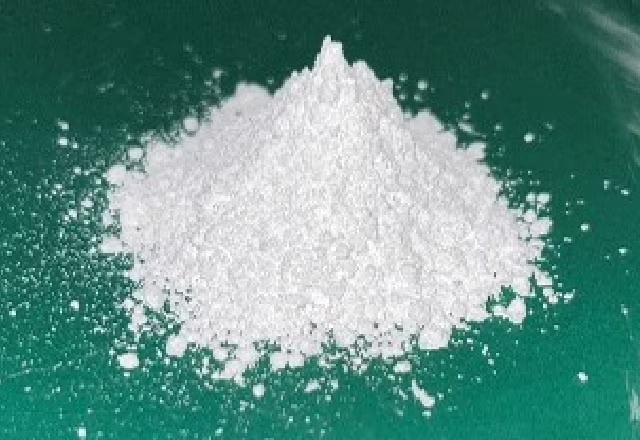
ZMP
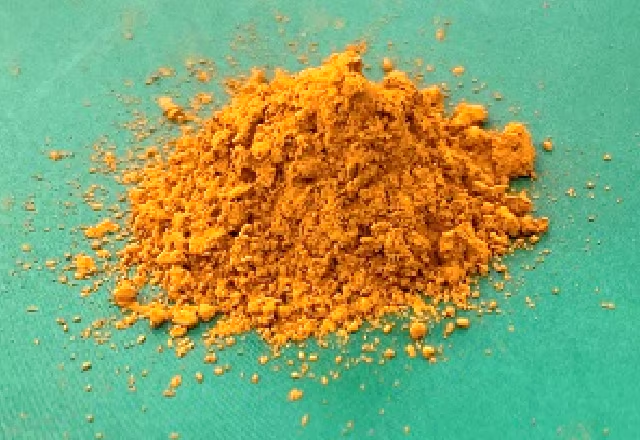
CZVPO
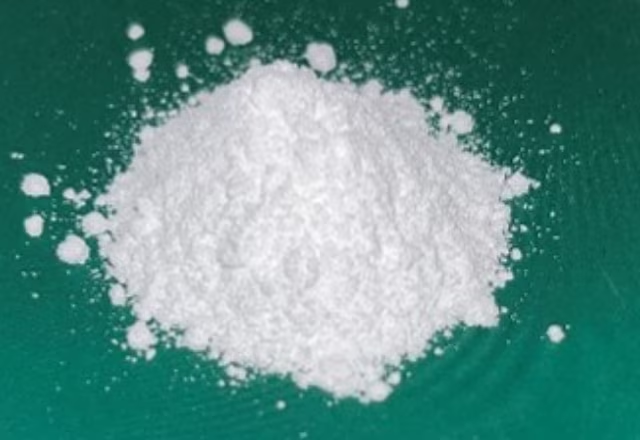
ZSP
FEATURES
Material Characteristics
This negative thermal expansion material TRANZiQ™ combines a high contraction effect, flexible customization options, and a wide operating temperature range, and
It delivers optimal performance across a wide range of applications. The three features are as follows.
01
High contraction effect
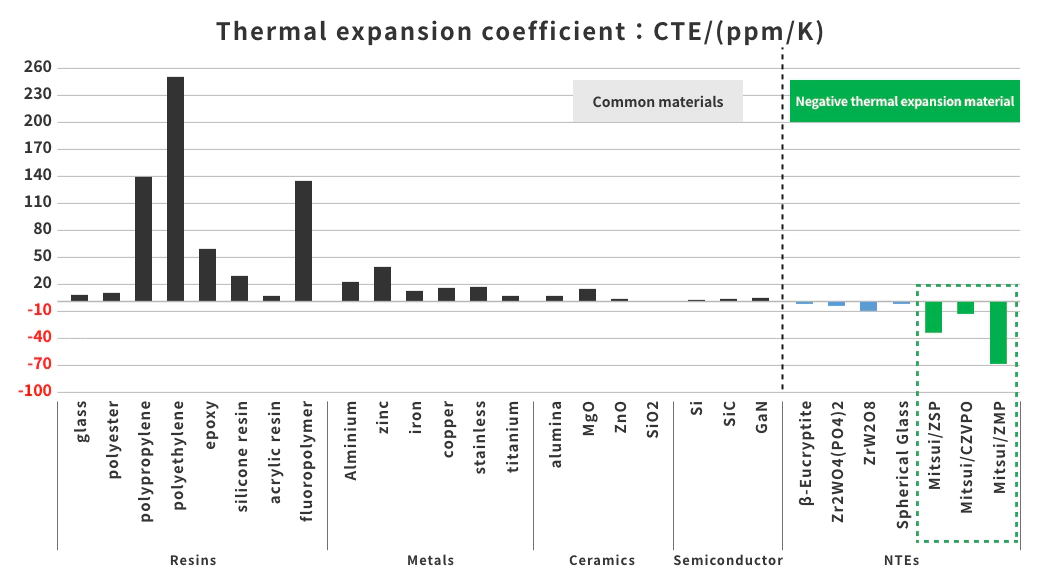
Compared to conventional negative thermal expansion material TRANZiQ™, the new negative thermal material developed by Mitsui Kinzoku offers world-class contraction performance. This ensures the long-term stability of the material.
02
Flexible Specification Changes
We offer a wide range of customization options to meet our customers' needs, including surface treatment, particle size control, and support for low-dielectric-constant grades.
This enables performance optimized for the specific application.
03
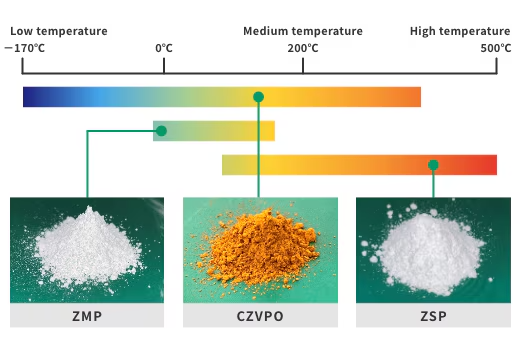
Covers a wide temperature range
Our negative thermal expansion material TRANZiQ™ are capable of withstanding temperatures ranging from sub-zero to high temperatures.
You can choose from a variety of grades depending on the temperature range in which you wish to minimize thermal expansion.
LINE UP
"Negative Thermal Expansion Material" TRANZiQ™ Line-up
Our negative thermal expansion material TRANZiQ™ exhibits a high degree of thermal contraction.
We can also accommodate various customization requests, such as surface treatment, particle size adjustment, and spheronization.
|
Temperature range |
Low |
Low~Middle |
Middle~High |
|
|---|---|---|---|---|
|
Substance |
ZMP |
CZVPO |
ZSP |
|
|
Maximum linear expansion coefficient*1 |
−66 ppm/K |
−12 ppm/K |
−38 ppm/K |
|
|
Features |
Excellent at near-room temperature |
Consistent across a wide temperature range |
The best in the high-temperature range |
|
|
Contraction Temperature Range |
°C |
-10°C to 80°C |
-170°C to 230°C |
100°C–500°C |
|
Average Particle Size (D50) |
μm |
4~5 |
2~10 |
0.6 |
|
Bulk density |
g/cm3 |
1 |
1 |
0.1 |
|
True Density |
g/cm3 |
3.7 |
3.9 |
2.9 |
|
Dielectric constant*2 |
- |
4.8 |
4.9 |
5.8 |
|
Dielectric loss tangent*2 |
- |
0.010 |
0.006 |
0.031 |
|
Heat Resistance (Thermal Decomposition Temperature)*3 |
°C |
900 |
650 |
800 |
ZMP, CZVPO: Invented by Professor Takenaka (Nagoya University)
ZSP: Invented by Professor Isobe (Tokyo University of Science)
*1 Coefficient of linear expansion *2 Cavity resonator JIS C2565 (10 GHz) *3 In air
CASE STUDY
"Negative Thermal Expansion Material" TRANZiQ™ Examples of Uses
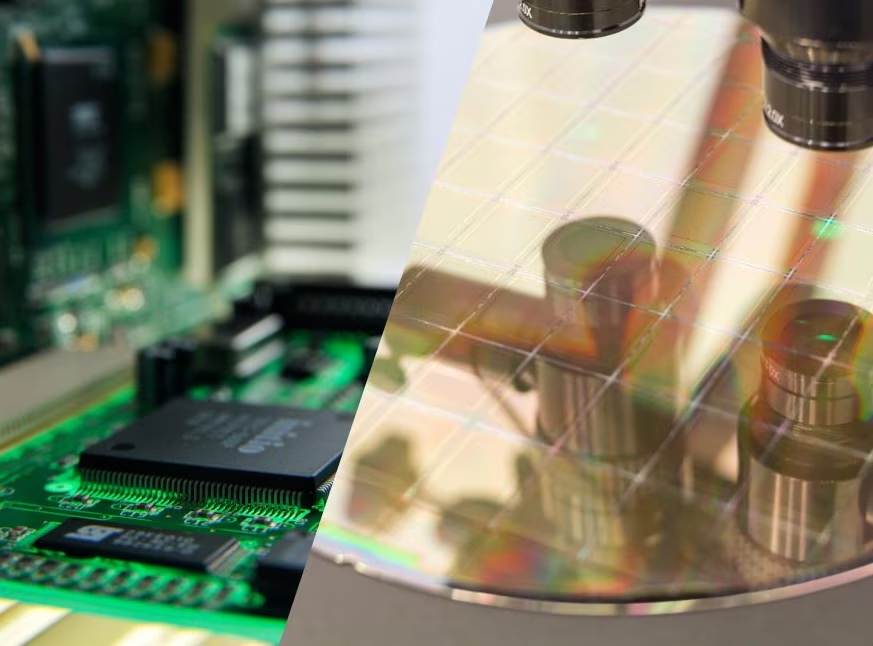
With the trend toward smaller and thinner electronic materials in recent years, it has become increasingly important to suppress the thermal expansion of these materials.
Our negative thermal expansion material TRANZiQ™ can be used in a variety of applications where thermal expansion needs to be suppressed.
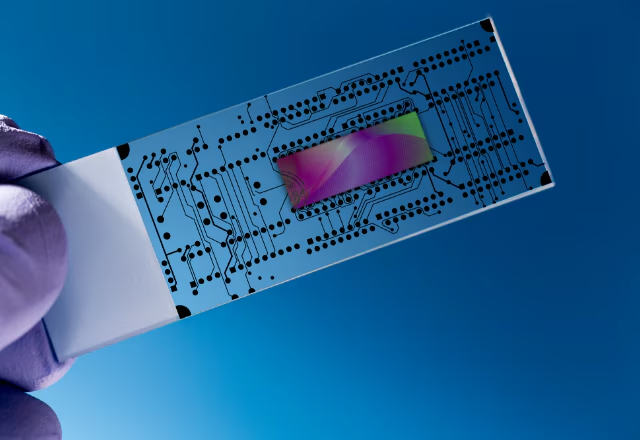
Sensor

Semiconductor Encapsulation / MUF / Copper-Clad Laminate